
The 1977 half dollar value depends less on the date than many collectors expect. The coin is common. It is not silver. Most pieces trade at face value or only a little above it. The better prices appear when the coin is a proof, a high Mint State example, or a confirmed variety.
That is why a 1977 half dollar should not be judged by the year alone. The first job is simple. Separate the type. Then check the surfaces. After that, compare the coin with the price levels that matter.
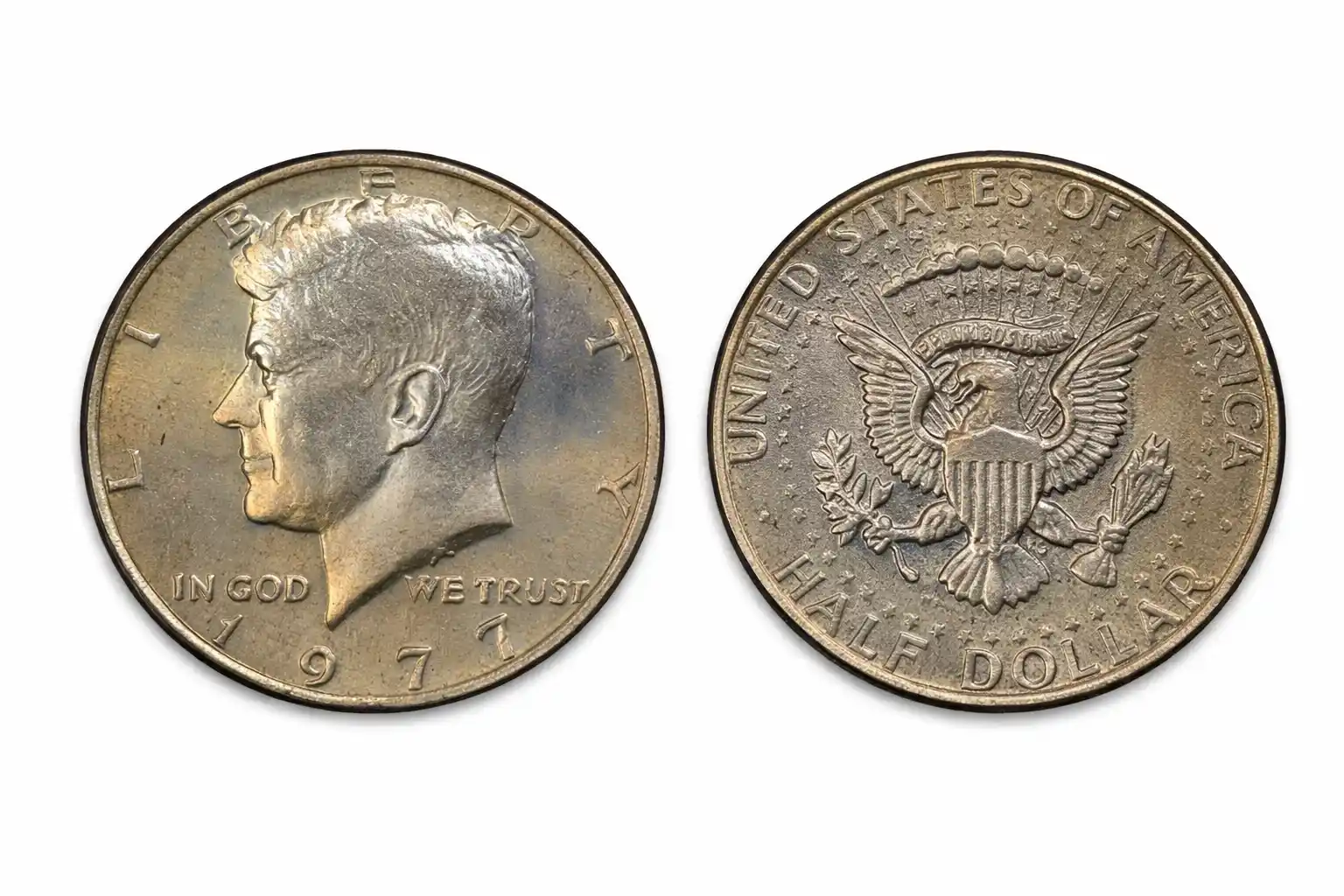
Why Most 1977 Half Dollars Are Worth Face Value
The 1977 Kennedy half dollar was struck in large numbers. Philadelphia made 43,598,000 pieces. Denver made 31,449,106. San Francisco made 3,251,152 proofs. All three are copper-nickel clad coins, not silver issues. Large supply keeps ordinary prices low.
That keeps most-worn pieces in a narrow range. Сirculated 1977 and 1977-D coins are about $0.60 to $0.75, near face value, and ordinary uncirculated pieces are in the low-dollar range. That is the right baseline for raw, common pieces.
A 1977 half dollar usually stays near face value if it is:
- Circulated;
- Heavily marked;
- Cleaned;
- Dull;
- Not a proof;
- Not a high-grade certified coin.
That list explains most pieces seen in change jars, inherited boxes, and dealer bulk trays. The coin becomes interesting only when it is clearly better than average.
Start With the Type
The first step is basic separation. A 1977-P and a 1977-D are business strikes. A 1977-S is a proof. Those are different markets. They should not be priced the same way. The ranges below reflect common market levels for normal examples, not elite registry coins.
| Version | Type | Typical Price Range | What Usually Makes It Worth More |
| 1977-P | Business strike | $0.50–$1.70 | High Mint State grade, stronger luster, cleaner surfaces |
| 1977-D | Business strike | $0.50–$1.50 | Better preservation, high grade, confirmed variety |
| 1977-S | Proof | $14–$32 | Deep Cameo contrast, top proof grade, clean fields |
These are normal collector ranges. They do not describe the top end. A certified MS67, MS68, or PR70 belongs to a different price profile.
Check the Condition First
Condition drives the market for this date. A worn coin stays cheap. An uncirculated coin can move above face value. A high-end Mint State coin can move much higher. For proofs, clean fields and strong contrast matter just as much as grade.
Quick signs that condition matters:
- No wear on Kennedy’s portrait
- Original luster still visible
- Fewer contact marks in the fields
- Clean rims
- No haze on proofs
- No hairlines across mirrored surfaces
A cleaned coin may still look bright, but the market usually discounts it. A raw proof with haze or fine hairlines also loses value fast. Surface quality matters more than many beginners expect.
Value Overview by Grade
The 1977 half dollar does not rise in a smooth line. It stays low for a long stretch. Then the price jumps late. That is common for modern clad issues with high survival rates. Common grades are easy. Top grades are not. The ranges below combine retail-guide levels with public auction records for stronger certified coins.
| Version / Grade Level | What It Usually Means | Typical Price Range | Market Meaning |
| 1977-P / 1977-D, circulated (G–AU) | Worn business strike | $0.50–$1.00 | Usually near face value |
| 1977-P / 1977-D, common Mint State (MS63–MS65) | Uncirculated but not top-end | $1.50–$5.00 | Small collector premium |
| 1977-P, MS67 | High-grade Philadelphia coin | about $141–$180 | Stronger premium starts here |
| 1977-P, MS67+ to MS68 | Top-end Philadelphia coin | $1,116–$5,750 | Registry-level market |
| 1977-D, MS67 | High-grade Denver coin | about $275 and up | Strong premium over ordinary pieces |
| 1977-D, MS68 | Top-end Denver coin | up to $4,285 | Condition rarity |
| 1977-S proof, PF65–PF68 | Typical preserved proof | $14–$32 | Usually above face value |
| 1977-S, PR69 DCAM | Better proof quality | about $15–$30 | Better eye appeal, still affordable |
| 1977-S, PR70 / top DCAM | Elite proof quality | $461–$1,323 | Thin top-end segment |
The table shows the pattern clearly. Most coins are cheap. High Mint State coins carry the real business-strike premium. Proofs are more valuable on average, but most are still affordable unless the grade reaches the top.
When the Coin Stops Being Ordinary
A 1977 half dollar stops being ordinary when one of the usual conditions changes. The coin must be better than the average raw example from the same date. That is the practical rule.
A 1977 half dollar is more likely to carry a premium if it is:
- A proof coin
- A clean Mint State piece
- Certified at a high grade
- A confirmed variety
- A real mint error
- Clearly stronger than average for the date
That is why two coins with the same date can have completely different prices. One may sit for fifty cents. The other may sell for hundreds or more.
Errors and Varieties: What to Check
Errors matter, but only real ones. Damage does not count. Scratches, dents, cleaning, and environmental corrosion do not create collector value. They usually remove it.
For 1977, the best-known variety is the 1977-D Doubled Die Obverse, FS-101. PCGS lists that variety separately and shows an auction record of $800 in MS65. That is a different market from a normal 1977-D. It proves the point: the premium belongs to documented varieties, not to random marks.
What may add value:
- Confirmed doubled die variety
- Off-center strike
- Broadstrike
- Other documented mint errors.
What usually does not add value:
- Scratches
- Cleaning
- Rim damage from circulation
- Corrosion
- Random post-mint abuse.
If the coin looks odd, compare it with known diagnostics before assuming it is rare. Most unusual-looking raw halves are damaged, not rare.
Proof vs Business Strike
Many beginners confuse proofs with nice business strikes. The difference matters because the value logic is different. A proof was made for collectors. A business strike was made for circulation.
| Feature | Business Strike | Proof |
| Purpose | Circulation | Collector issue |
| Surface | Standard finish | Mirror-like fields |
| Usual value | Near face value to small premium | Usually above face value |
| Main premium driver | High grade | Surface quality and top proof grade |
| Common risk | Wear and bag marks | Hairlines, haze, impaired fields |
This is why a 1977-S often sells above face value even in ordinary proof grades, while a normal 1977-P or 1977-D may not. The proof starts in a different tier. The business strike must earn that premium under the condition.
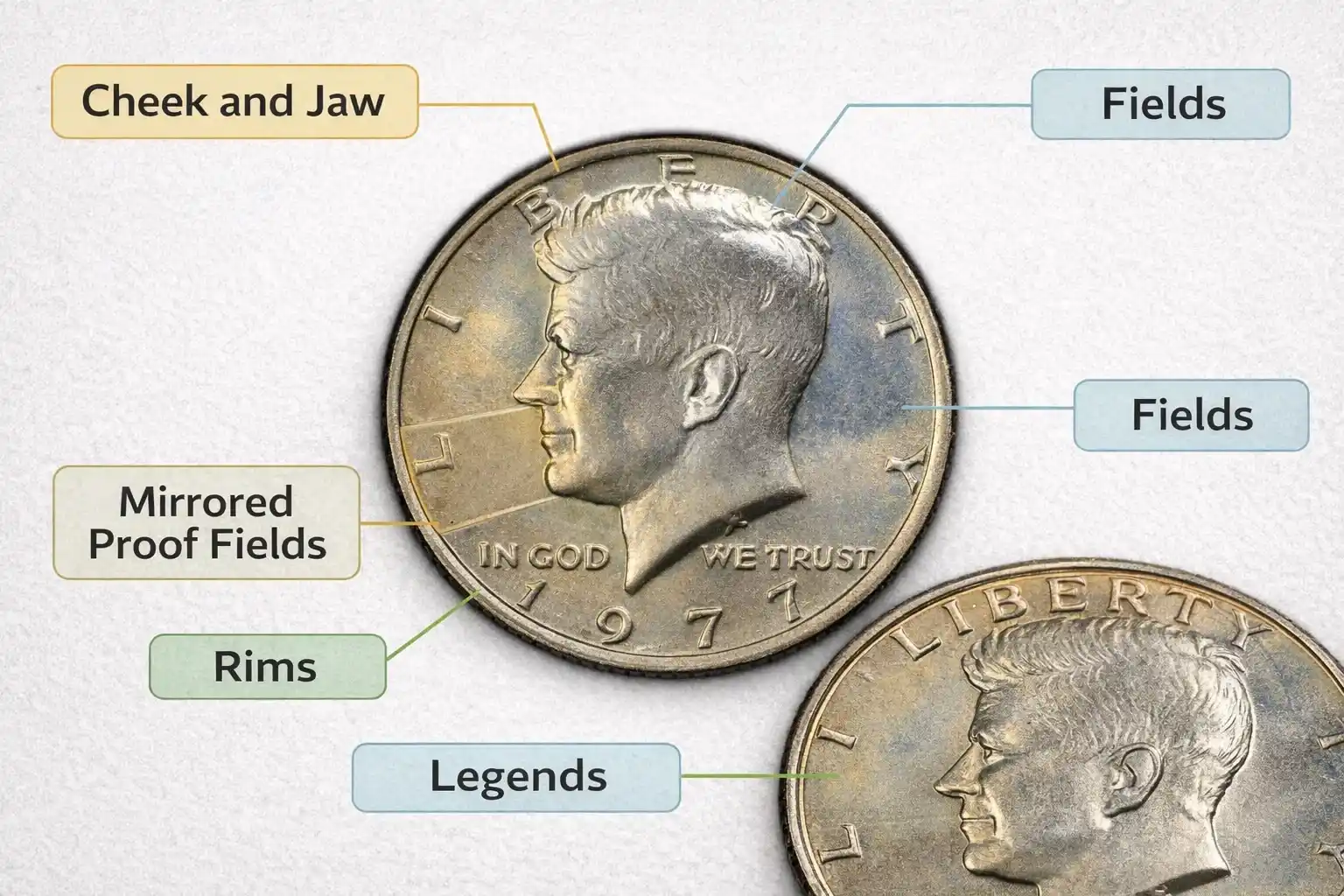
A Practical Check Before You Estimate the Price
Before pricing the coin, sort it correctly. A coin identifier app can help separate types and mintmarks, but the user still needs to judge finish, wear, and surface quality by eye. That second step matters more than the app result on a common 1977 half dollar.
Before you estimate the price, check these points:
- Confirm whether the coin is P, D, or S.
- Separate the proof from the business strike.
- Check Kennedy’s cheek and jaw for wear.
- Look at the fields for marks or hairlines.
- Decide whether the coin is circulated or Mint State.
- Check whether the surfaces look original or cleaned.
- Look for signs of a known variety or mint error.
- Only then, compare the coin with real market ranges.
This order keeps pricing mistakes down. Many overvalued raw coins fail at step two or step five. They are common business strikes or impaired proofs, not premium pieces.
What Raises the Price Most
The 1977 half dollar is a date where a few factors do nearly all the work. The year itself is not enough. The market pays for quality and for unusual status.
The main value factors are:
- Condition
- Proof status
- Highly certified grade
- Confirmed variety or error
- Original surfaces
- Collector demand for top-end pieces.
That list is short, but it explains almost every price result for this date. A common coin with weak surfaces stays cheap. A sharp coin in a top holder moves into a different segment.
FAQs
Is a 1977 half dollar silver?
No. Regular 1977 halves are clad coins with outer layers of 75% copper and 25% nickel over a pure copper center. That is one reason ordinary pieces do not have a silver floor.
How much is a 1977 half-dollar worth in circulation?
Most circulated 1977 and 1977-D coins sit around $0.50 to $1.00, with NGC placing circulated levels around $0.60 to $0.75 and general retail guides keeping average circulated pieces close to face value.
Is a 1977-S proof worth more than a regular 1977 half dollar?
Usually, yes. Common 1977-S proofs often trade around $14 to $32, while average business strikes remain much lower. The proof market becomes stronger again at PR69 and especially PR70.
What is the most valuable normal 1977 half-dollar type?
Among normal issues, the top-end business strikes and top proofs bring the strongest prices. PCGS lists a 1977-P MS68 auction record of $5,750, and GreatCollections shows a 1977-D up to $4,285. PCGS lists a 1977-S proof auction record of $1,323 in PR70.
What error should I look for?
The best-known one is the 1977-D DDO FS-101. PCGS records that variety separately and shows an $800 auction record in MS65. That gives it far more upside than a normal raw 1977-D.
Is a 1977-D better than a 1977-P?
Not in ordinary grades. Both are common. The difference shows in higher certified grades and in confirmed varieties. Denver pieces can bring strong premiums in MS67 and higher, but only when the coin is truly superior.
Is Your 1977 Half Dollar Worth More Than Face Value?
Most are not. That is the clean answer. A worn 1977 half dollar is usually just a fifty-cent coin with a small collector premium at best. A normal uncirculated piece improves, but not by much. The high prices start late. They belong to high-grade business strikes, cleaner proofs, and confirmed varieties.
For collectors who want a free coin identifier and value tool that also keeps coins in a digital collection, adds smart filters, and includes an AI helper alongside photo-based coin cards. The Coin ID Scanner fits naturally into that workflow. Its value is not just naming the coin. It also helps organize, compare, and review pieces after the scan.
The practical rule stays simple. Check the type first. Check the surfaces next. Then compare the coin with the right grade range. That is how a common 1977 half dollar stops looking ordinary.